Adaptations
There may be instances where your client’s communication challenges can overshadow their true abilities. Therefore, consider identifying and addressing potential barriers to communication (e.g. hearing impairment, visual impairment, language barrier) in the process of your assessment. When necessary, practicable support through the provision of communicative support, can help your client be more effective in their communication, and enhance the validity of your assessment.
Support can be provided in different capacities, and are available in different forms, enabling a communication between all parties during the assessment.
Language
Despite the prevalence of the English language globally, there may be individuals who are more proficient in communicating with their own mother tongue. In such cases, tailoring the language of an assessment to a specific client may be beneficial for effective communication and understanding. In adhering to the 5 Statutory Principles, an assessor should take all practicable steps to support the needs of the client, during the process of assessment.
How?
Written Language
Delivering the assessment and communicating with the client in their preferred language of communication can potentially elicit higher levels of engagement and expression for clients.
Sign Language
The execution of sign language through oneself or an interpreter
Gestures
Speech in the clients’ favoured language of communication accompanied by clear, easy to interpret gestures, to allow for simplicity in comprehension
Technology
Technological aids are invaluable in mental capacity assessments, allowing for communication amongst clients who may be non-verbal, or require support due to physical immobility. Various levels of technology are put into the devices, catering to for the different types of support needed, acting as a voice for clients to express and communicate their thoughts daily.
Augmentative & Alternative Communication Tools (AACs)
Augmentative and alternative communication (AAC) tools provide an alternative channel for clients’ who have limited verbal skills, or are non-verbal, to better communicate.
AACs are normally divided into these 2 types:
The use of AACs can be either on a temporary or permanent basis, depending on the clients’ needs. Longer-term users of AACs are normally those with congenital disorders or disabilities.
The main objective of AACs have always been to enhance and support an individual’s ability to communicate. As such, they have been categorised into 3 different categories, with varying levels of support and technological advancements being applied. Below you will also see examples of AAC tools with varying levels of technology being implemented into the devices to best cater to an individual’s needs.
-
Utilising systems/devices to supplement someone's natural speech.
-
Utilising systems/devices to replace someone's natural speech.
-
Use of sign language, gestures, facial expressions, body language, and even non-linguistic vocalizations.
Such methods have long been considered an essential tool for helping people with limited verbal skills communicate.
-
The use of picture symbols, drawing tools, communication boards, picture books, etc.
Low-tech devices include a limited number of ‘static’ displays that cannot generally be changed.
-
Digital technology such as iPads and computers with text-to-speech software. Amplifiers and devices with pre-recorded messages also fall into this category.
High-tech AAC devices are often ‘dynamic’, meaning they can generate different words, phrases, or messages to suit the user’s immediate communication needs.
Note: A distinction should be made between communication softwares in the form of mobile applications, and standalone devices that only support its communication function. Whilst communication softwares are readily available in the form of mobile applications, standalone devices are better for usability and durability purposes in the long run.
The link below brings an insight onto the various technological supports offered to clients who require communication support.
Auditory
A client may be required to receive permanent auditory support, or may be completely unable to hear. Consider ensuring that your client has the necessary supports for their hearing needs.
Auditory Impairment
When a client has an auditory impairment, a hearing aid may be used to support the auditory functions of the client. Consider seeking support from their caregivers to ensure your client has access to a working device for the assessment. Accommodating to the auditory impairment can include adopting positive body positioning when speaking to the client to ensure clear identification of the speaker to the client.
Volume of Speech
Over the course of the interaction with a client, they may be described as tone-deaf, irrespective of their ages, and adjustments may have to be made to the volume of speech that anyone interacting with the client may be using. This can mean that interaction with the client will have to be in a louder than usual volume in order for the client to be receptive to the words and questions that may be directed to them during interaction.
Visual
Visual aids can help to facilitate and deliver messages which may be to put across in written text or through verbal speech. Some clients may require support to understand a question, whether it be through the use of simpler language, or having the question be presented in a more simplistic manner to better facilitate the client’s thought process.
Shown below are suggestions of visual aids from materials that has been created and curated for past ADAP-MCA assessments. They may provide inspiration for you to further develop and improve on.
Sorting Tasks
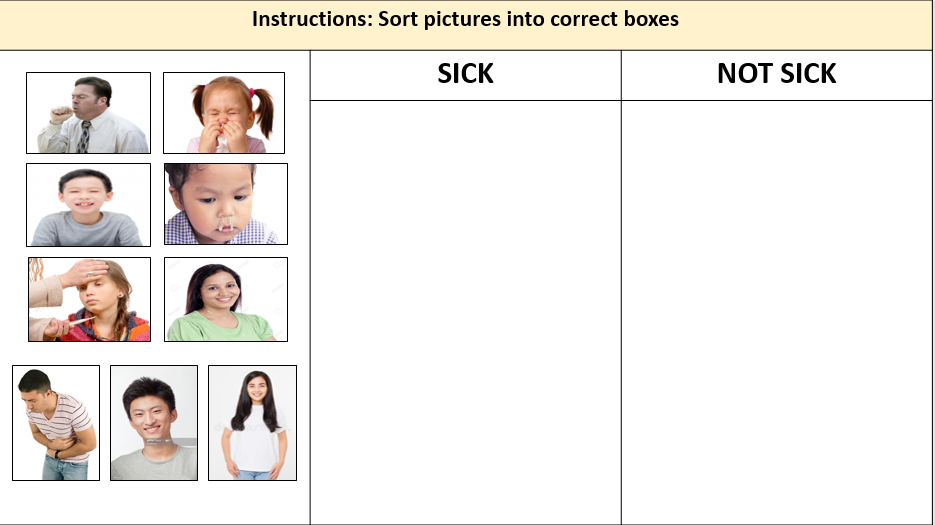
Preferences, accompanied by categorisation task
This task is aided usually by pre-generated labels to assess a clients’ ability to reason and assess the benefits and drawbacks of a context-specific decision
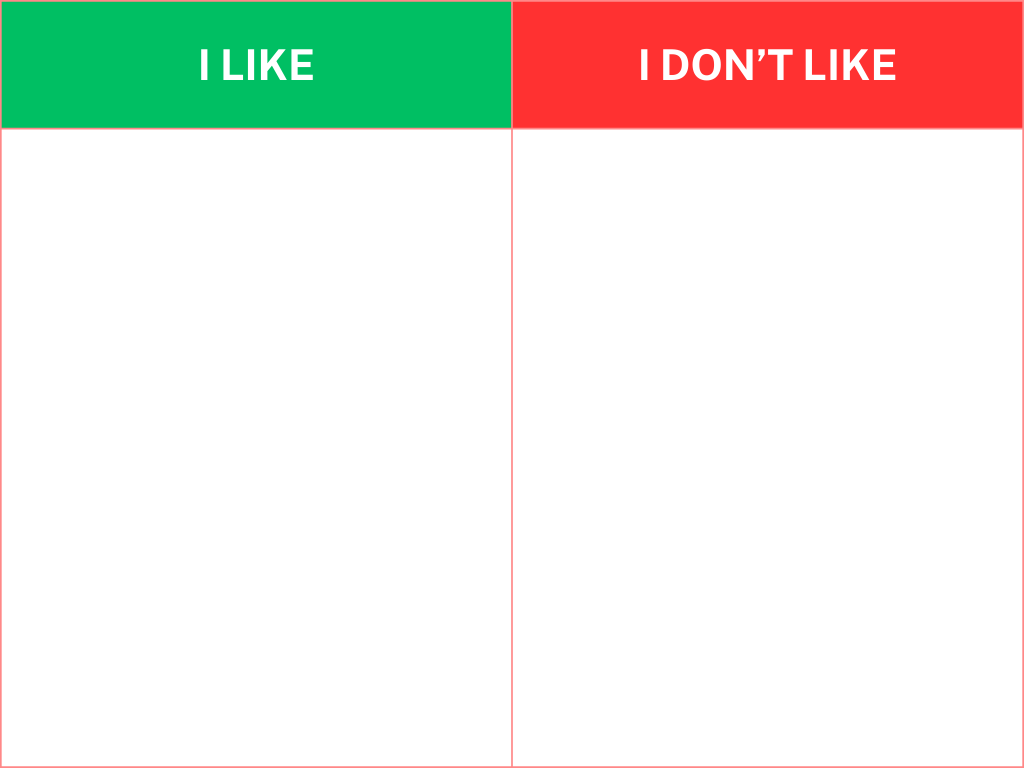
Decision Making Tree

Reasoning Tasks
Based off a decision, the client is then asked to elaborate on their decision based off the suggestions listed below to evaluate if they are able to comprehend their decision, as well as express their reasoning behind it
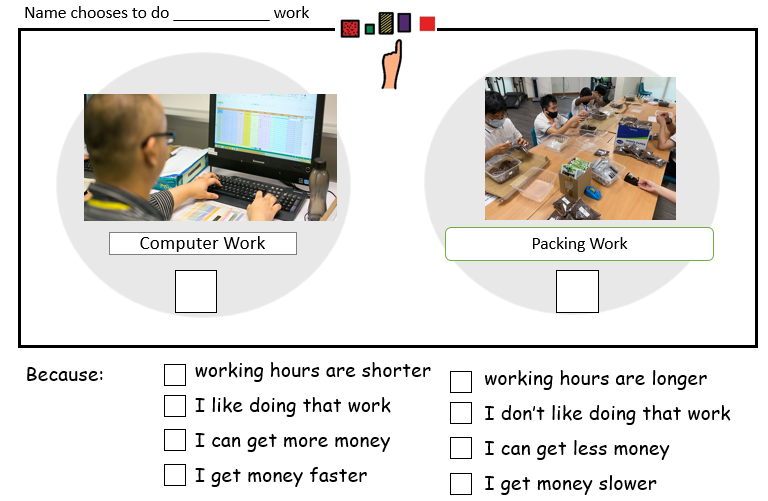
The materials shown above are some suggestions based on our existing materials. They were designed for use during the assessment process to support the clients’ needs to the best of our abilities. You may have alternatives available to you.
If you would like to further enquire about the potential resources available, please drop us an e-mail at adap.mca@cph.sg.