Assessment Process
This section covers the bedrock of conducting a mental capacity assessment.
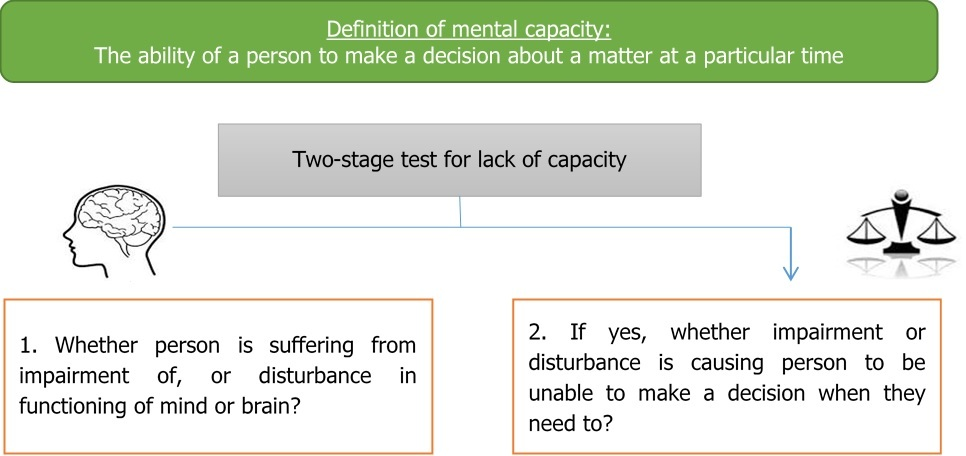
The assessment of mental capacity consists of two stages, that have to be fulfilled in chronological order.
Step 1:
The first step of the test examines if the person has an impairment of, or disturbance in functioning of mind or brain. These are some conditions that may cause a lack of mental capacity. These may include:
• Stroke
• Brain injury
• Dementia
• Mental health problems
• Intellectual disabilities
However, it must not be assumed that a person who suffers from any of these conditions necessarily lacks mental capacity.
Areas to test and examples of tests that can be used for MCA
-
Determine whether P is oriented to
Time (e.g. year, month, day of the month, day of the week, estimate of current time without referring to the clock)
Place (e.g. home address, where are we now – country, name of place)
Person (e.g. Name, NRIC number, age, date of birth, current prime minister of Singapore)
Please refer to sample orientation questions from Abbreviated Mental Test (AMT), Mini Mental State Examination (MMSE), Montreal Cognitive Assessment (MoCA), Wechsler Memory Scale, 4th Edition (WMS-IV) Brief Cognitive Status Exam.
For individuals who might be lower functioning or non-verbal, consider supporting them by giving them 3 to 5 visual stimuli and asking them to pick the correct answers for the above orientation questions. We can also test whether they can accurately recognise personal information by showing them photos of their family members, room, interior and exterior view of the house, as well as current medication.
For lower functioning individuals, it will also be good to determine their language skills (especially their ability to comprehend instructions), basic literacy (e.g. alphabet knowledge, reading comprehension skills, written ability) and numeracy skills (e.g. ability to identify and understand numbers, arithmetic / computational skills).
-
Determine P’s adaptive ability and daily functioning skills
Tools such as Client Assessment Form – Revised (CAF-R) and Vineland Adaptive Behavior Scales, Third Edition (Vineland-3) can be used to get an understanding of P’s ability in activities of daily living, mental and community living needs, communication and socialization skills.
-
If there is a need to determine P’s current intellectual functioning ability (e.g. there were no previous cognitive assessment, and application for ADAP is made based on P’s lowered intellectual functioning ability), one of the following tests can be considered:
Singapore Ability Scales (SAS)
Wechsler Adult Intelligence Scale, Fourth Edition (WAIS–IV)
Stanford-Binet Intelligence Scales, Fifth Edition (SB-5)
Wechsler Abbreviated Scale of Intelligence, Second Edition (WASI-II)
Comprehensive Test of Nonverbal Intelligence, Second Edition (CTONI-2)
Test of Nonverbal Intelligence Fourth Edition (TONI-4)
-
Apart from the above tools, below are some other possible tools that can be used if we suspect that P’s ability in certain cognitive domains may affect their decision-making skills
Clock Drawing Test
Repeatable Battery for the Assessment of Neuropsychological Status Update (RBANS Update)
Delis-Kaplan Executive Function System (D-KEFS)
Color Trails Test (CTT)
Symbol Digit Modalities Test (SDMT)