Why Competencies?
We identify the competencies needed for conducting mental capacity assessments to ensure accurate, reliable, and ethical evaluations of an individual's ability to make decisions.
As outlined in Guideline 5 within the SPS code of ethics, psychologists are responsible for maintaining competence, and perform duties within their boundaries of competence. Outlining competencies enable psychologists to identify individual needs and strengths, to maintain:
Effective assessment process
Good standards of practice
Effective supervision

What is it?
A mental capacity assessment is an assessment that often has legal implications. Therefore, the identification of relevant competencies of assessors can help practitioners uphold ethical standards, and promote an evaluation process that balances protection while safeguarding the rights and well-being of individuals.
While the process involved in conducting a mental capacity assessment do not vastly differ from other psychological assessments, there are a range of knowledge, skills, and attributes that would enable a professional to conduct the assessments effectively. The competency framework highlights these behaviours necessary of a mental capacity assessor within ADAP.
Within the Assisted Deputyship Application Programme (ADAP), psychologists are often the practitioners conducting the mental capacity assessment.
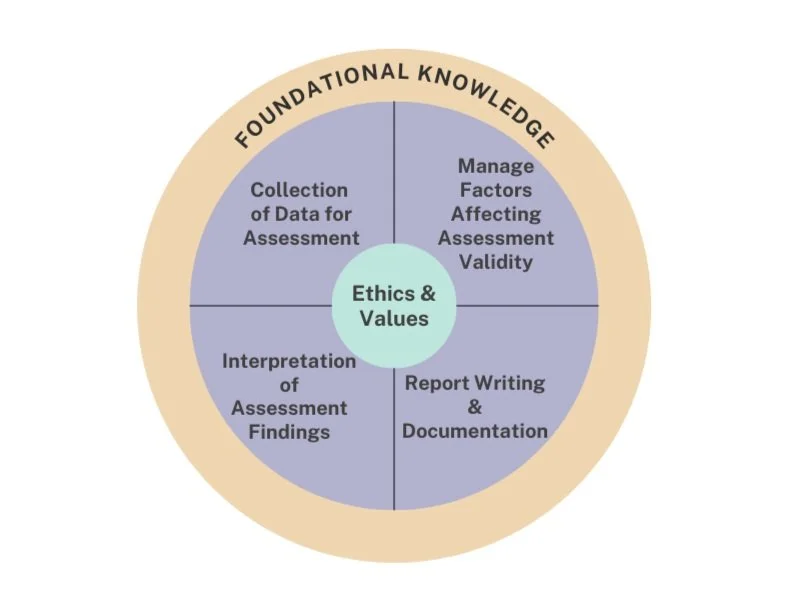
The Core Competencies
The competency framework was created through a process that combined reviews of best practices in countries with the Mental Capacity Act, with practice wisdom of psychologists conducting mental capacity assessment in ADAP. This process highlighted six broad areas of competencies that will be briefly described below.
At the centre of the framework, ethics and values are fundamental to all aspects of mental capacity assessments. These core competencies guide assessors in maintaining professionalism and integrity throughout the assessment process.
The four quadrants inside the circle represent the critical skills and knowledge areas.
-
Refer to the assessor's ability to gather accurate, relevant information through interviews, observations, and records to inform the mental capacity assessment.
-
Involves the capacity to recognize, mitigate, and manage individual and external factors that may influence the outcome of the assessment, ensuring its validity.
-
Refers to the skill of analysing and interpreting the data collected, drawing appropriate conclusions aligned with the legal requirements of mental capacity.
-
Entails proficiency in clearly documenting findings and producing reports that are comprehensive, concise, and accessible to all relevant parties.
Surrounding the core, foundational knowledge encompasses essential understanding of the Mental Capacity Act and the Assisted Deputyship Application Programme, which assessors need to apply across all phases of the assessment.
How do we use it?
The competency framework can be used together with information from the learning resources on this website. The learning resources incorporates information that would help an assessor address these competencies, while the competency framework summarises these behaviours within a set of rubrics. The rubric can be used as a point of reference, to identify behaviours necessary for an assessor to embody while conducting a mental capacity assessment for adults with developmental disabilities.
The rubric is a tool that we can use in a number of ways:
A self-assessment tool in a self-reflective practice for professional development. This can be useful to build self-awareness.
For skills analysis, training, and career development plans. It allows practicing and supervising psychologists to identify continuing professional development opportunities and training needs.
In the development of learning and development. It can be used to design relevant training materials for ADAP-MCA assessors.
Within the rubrics, you will find a rating scale. The scale follows a simple 3 point scale, that ranges from a developing to an advanced level of competence. The scale is designed for self-reflection and supervision purposes.
Definition of rating scale:
Developing: refers to an observation of emerging evidence of behaviours reflected in the unit.
Sound: refers to an observation of most behaviours reflected in the unit.
Advanced: refers to an observation of all behaviours reflected in the unit.